I felt the need to compose this because there is so little information out there for parents to find when it comes to bracing options with clubfoot treatment. If you’ve followed our Clubbie Adventures you know that we made the choice early on, prior to our daughters birth really, that we would use a unilateral brace after casting. While this seemed like the most logical decision for us it was NOT the easiest option to find information about, procure, or gain clinical insight into. It took some major digging and months and months of research to get answers to our questions. If I had only been able to access the information that we have now our journey could’ve been less stressful. For anyone out there considering a unilateral bracing option for their child I hope this information helps you weigh the options and have some clarity.
Our first chance to learn about the unilateral options was on a Facebook Group where other clubbie families conversed about their journeys, had it not been for this group I would likely never have even known that there was an alternative to the “boots and bar” which is unfortunate. Probably the most obvious reason for the lack of readily available information is due to the lack of support from doctors for a unilateral brace. Every clinician we spoke to about this was adamantly against using anything that deviated from the classic Ponseti method of treatment which includes a bilateral foot abduction brace. My first thought was that if all of the doctors are against this there must be a very good reason. To make a long story short they have a reason, that reason is simply that the boots and bar have been used since the 1950’s and have proven to work considerably well in preventing relapse after treatment. The other options available haven’t been around as long so their data is not as far reaching. It’s not that the alternative options don’t work it’s merely because one is tried and true and physicians don’t like to deviate from tried and true even if an alternative may prove to be a better option.
Our Reasoning For Choosing Unilateral
Despite the majority of opinions by the clinicians out there I persisted in our choice to use a unilateral brace for the following reasons. These reasons were dismissed repeatedly as “non-issues” by all of the orthos that we talked with but I wholeheartedly disagree with their lack of concern for any of the following, and with good reason. The pictures speak for themselves.
Unnecessary hindering of the unaffected foot
I never understood the concept of binding both feet together when only one was affected. It reminded me of the saying “don’t cut your nose to spite your face.” This idea contradicted logic for me from day 1. No matter how much I researched to understand the purpose of bracing both feet together I could never shake the feeling that this was completely counterintuitive. I had concerns about development down the road by hindering a perfectly “fine” foot and leg for the sake of the other. It made more sense to allow the unaffected limb to be just that, unaffected, while treating the other one.
Excessive strain to the lower limb joints from a fixed bar
I couldn’t even count how many photos I saw of kids in their boots n bars that looked like some sort of circus contortionist act. The positions these kids could get into, usually while sleeping, were cringeworthy. Many with legs completely twisted around and facing the wrong direction. At minimum each child was mimicking the “W sitting position” which is known by all physical therapy folks to be terrible on the knee and hip joints. It became so concerning to me that I started taking screenshots of these photos to show to our potential clinicians in an effort to gain some sort of understanding into how this was considered acceptable. It seemed that you were treating one orthopedic issue while creating about 10 more. To this day I am a firm believer that there is no way that this kind of continual strain on the joints doesn’t cause problems in the long term.
Severe blistering and pressure ulcers
In addition to the joint strain I witnessed in photos I saw the same amount, if not more, of poor tiny babies with SEVERE tissue traumas resulting from an intolerance to the boots and bar bracing system. Kids would fight and fight to free their feet from the brace that they’d rub blisters so severe they needed treatment in a burn unit. Or they’d end up with deep pressure ulcers from the tight boots because the boots have to be wrenched down enough to prevent the foot from slipping. That would lead to having to remove the brace until the wounds healed which often times required a holding cast. It seemed like a ridiculous and vicious cycle. These stories became so frequent that I finally took a formal poll asking for any parents that had used the BNB without issues to come forward because it was seeming more and more like every kid had some sort of issue. To my surprise there were many parents with stories of success but it never quieted that worry in my brain nor erased the photos. (Also of note, while not always the case, one of the main reasons for brace intolerance (any brace) is from putting a foot into bracing that is NOT fully corrected. This is a separate issue that I will discuss in a future post.)
Logistical mobility problems for older children
I had a hard time seeing how kids of walking and potty training age were going to be able to make it to a bathroom in the middle of the night. How would they be able to walk at all? What about an emergency or a fire? Sleepovers? After all, the recommended age for bracing continues until around 5 and sometimes 6 years old depending on physician. These were smaller concerns but still valid.
Unilateral Bracing- Not The Easiest Choice
It was obvious after a few conversations with various doctors that our choice to go with a unilateral option was going to be anything but easy. We were deviating from the norm and definitely swimming upstream. But we were confident in our choice being the best option for our daughter. If you are strongly considering this as an option for your child just know that it is going to be a rough road and you will likely have to defend your choice over and over to professionals who disagree with you. Don’t worry there are plenty of us out there going through the same thing, we’re trying to open the minds of the medical professionals and push the field of orthopedics to advance!
I kept thinking how does a doctor or the medical field in general qualify an alternative bracing option if no one will allow their patients to use anything “new”? How do we get the data if no one can try new technology? How does the orthopedic field and medicine advance if no one is willing to try? Therein lies the struggle for all of us clubbie parents choosing to deviate from the norm for the sake of providing the best option for our children. We are all making a very difficult decision to contradict the majority of professionals with our own convictions that this alternative truly is the BETTER option for our children. We have an arsenal of information, testimonials, and research that support our convictions but it all falls on deaf ears because the physicians don’t want any part of it. I had one orthopedic surgeon tell me that he wouldn’t even look at this “new” brace until it had been around for 40 years. I tell you what, if the rest of the field of western medicine moved at this type of snails pace our world would be a much different place. There is a reason that western medicine is considered the gold standard and this would not be the case if we never made advancements or we thumbed our nose at every new technology, new vaccine, new medication, new imaging software, new surgical techniques without a half a century worth of data.
My biggest contention with the physicians perspective is that they have families ready and willing to pioneer this alternative advancement in bracing technology yet they refuse to facilitate it. As such, it makes the process of selecting and obtaining any other brace a very tricky one for families. There are not only logistical issues there are financial issues. A lack of physician support means that there are patients using the technology that can’t trouble shoot their concerns with anyone other than other clubbie families on a Facebook page that are also doing things blindly. The stubbornness is a detriment to the entire world of orthopedics. Yet despite this we are pushing forward, our kids are doing well, and we are confident and steadfast in our choice to pioneer this advancement no matter how hard they try to squelch us.
Unilateral Bracing Options
Among my research I landed on 2 basic alternatives to the boots and bar. They are very different braces but both are unilateral and offer similarities in function to abduct and dorsiflex the foot.
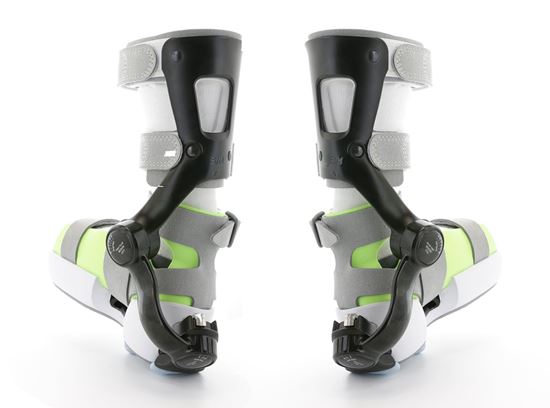
The ADM and the DTKAFO are the main alternatives around. Their features and descriptions are below along with contact information about where to order them and other frequently asked questions about them.
Originally supplied by MD Orthopaedics in the US for sizes 6 and up AND by C-Pro Direct in the United Kingdom in ALL sizes, this brace has been reworked in design now through Kiddfoot LLC. The US company had discontinued sales of the smaller sizes (0-5) as of early 2018 in an unfortunate turn of events but seems to be an evolving situation so worth a chat with your physician about current options. This brace is available for order through orthotic companies like Hangar Clinic and is covered by many insurances.
The original “boot” portion of the brace was the same design as the Mitchell Boot for the boots n bar and was also designed by John Mitchell in collaboration with the Morris’ family in the UK. You can read more about this and the inception of the ADM over here. It clicks in to the ADM portion of the brace that contains the spring action that dorsiflexes and abducts the foot. The newer boot is a reworked version of the Mitchell boot and still functions the same.
This brace is dynamic in nature in that it is not a fixed brace like the boots n bar, it provides gentle continuous stretching to 30 degrees of abduction and 15 degrees of dorsiflexion. The bracing schedule for the ADM usually follows that of the traditional BNB schedule starting with 23 hours of wear time and slowly weaning down to night and nap time wear.
Sizing is the same as that of BNB, each sandal has a corresponding spring strength that can be adjusted lighter or stronger depending on the child. As such, the ADM requires more vigilance to make sure it is holding the foot in an appropriate position as the child grows. Sizing up more often is typically necessary to maintain an adequate spring strength as opposed to BNB where you can get away with pushing the size limits to save on the cost of constant boot replacement.
One other mentionable point on the ADM, because the boot portion is the same as the BNB boot doctors seem to be a bit more open to trying it as an alternative since it has some familiarity to them.
The founders and owners of the ADM and C-Pro are wonderful to work with, as is their team. They are very knowledgable about the industry and have a personal connection to the clubfoot world as the product was developed for their son who was born in 2004 and had a rough road to correction as a clubbie.
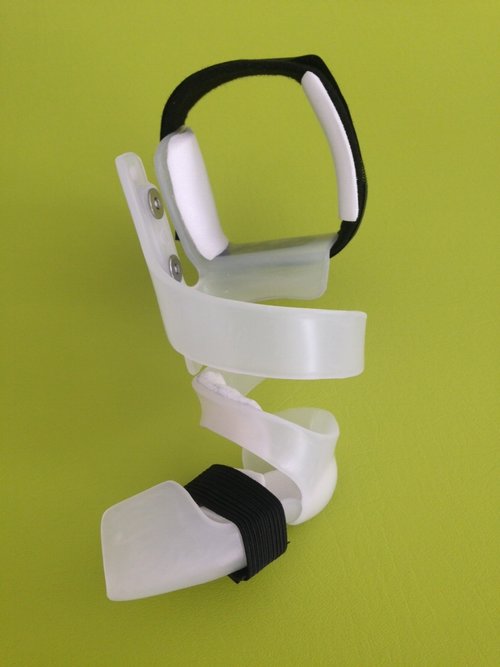
The DTKAFO was developed by Jerald Cunningham in Maine.
This brace is a custom fit orthosis designed to each child by traveling to Maine, as the child grows additional orthosis are adjusted and designed. It works like a spring providing continuous stretching to dorsiflex and abduct the foot similar to the ADM. It is worn full time, 23 hours a day, until the baby is walking and then for naps and nighttime until around age 3.
A 2 year cohort study demonstrates similar occurrence to correction vs relapse in patients using the DTKAFO vs traditional boots and bar.
To my knowledge these are the only 2 unilateral bracing options currently available on the market.
The Debate I Propose To Reluctant Clinicians
The following is a compilation of various thoughts I have concerning physicians reluctance to support a unilateral brace. There are many flaws in their arguments. The biggest being the ability to pinpoint specific causal information that can lead toward relapse and decline of previous correction. That is the key to justifying their reluctance to offer a unilateral bracing option, their concern is that the patient may relapse.
While this is the concern for all patients including those using boots and bar braces there is a greater concern that a unilateral option may increase these odds. However, there is NO DATA to support this concern. In fact, the data available to support the use of the traditional boots and bars (BNB) is flawed in and of itself because it does not delineate the vast amount of variables that may impact a patient’s likelihood of relapse.
For example: Casting done expertly from the very beginning vs improper casting. Changing just those 2 variables could cascade to a completely different conclusion. These variables could drastically effect a patient’s outcome yet doctors negate their significance and use a one size fits all approach as gospel for treatment recommendations. This philosophy contradicts their argument against an alternative bracing method.
What they do know is that there is plenty of evidence that casting followed by BNB for 5 years demonstrates good evidence of maintained correction. But how do we lay our hat on the success coming from the BNB, the success may be due to the casting, it may be due to other factors. One such factor that we know is absolutely applicable is bracing compliance. What doctors also fail to address is that there is likely increased odds of compliance when you are using a unilateral brace vs the BNB simply due to patient tolerance.
If they could reason the variables more specifically we may be able to actually hone in the success of treatment based on each factor that goes into these protocols.
In the world of medicine, in order to establish a governing standard for care research must show with evidence based practice that A + B = C. Or at least that there is a high probability that A+B=C. This is the only way that practice changes occur.
To establish this standard of care the data must be CLEAR. Unfortunately we have an established standard, to solely use the boots and bar for bracing, without that clear data. There are dozens of variables affecting a clear conclusion for treatment success/failure.
More Variables Affecting Current BNB Data
Casting done expertly with no issue prior to entering BNB vs corrective casting after improper treatment
Number of casts performed
Standard casting schedule vs accelerated casting schedule
Unilateral vs Bilateral
Age at start of treatment
Genetics/family history (indicating potential issues outside of the physiological issue of clubfoot)
Any other health issues at play (arthrogryposis, spina bifida, etc all of which could affect musculoskeletal components leading to relapse or lack thereof)
Atypical or Complex cases vs. straightforward cases with no issues
Tenotomy vs no tenotomy
Plaster casts vs non-plaster fiberglass casts
Mitchell boots vs. Markell boots
Bar type (Dennis Browne, Ponseti, Dobbs)
Bracing schedule (full time to 18 hour vs full time to 12 hour)
Bracing length (2 years, 3-4 year, 5+ years)
Parent compliance with bracing schedule
So in order to draw a statistical likelihood of the success of our treatment and establish/predict our own personal likelihood of a relapse moving forward I would need to evaluate a case study with the following variable cascade:
Brace until 4 years old
100% parent compliance with bracing schedule
The data at the end of this and subsequent conclusion for this patient could be vastly different than a patient with only one different variable let alone with multiple different variables. Yet we are making sweeping global opinions on treatment success/failure as one size fits all.
It would be nearly impossible to carve out reliable data from “studies” that don’t take this obvious difference into account yet that is what is being done. There is a loose correlation that strict bracing with boots and bar after proper casting prevents relapse but that doesn’t mean the correlation stems solely from the type of brace used. There could be other cascades of variables that that lend the same results. Including the use of a unilateral brace.
What’s most interesting is that while there is a general agreement that the Ponseti Method is the ONLY method that should be utilized in the treatment of clubfoot there are actually differences in the practices of these Ponseti practitioners and these differences are somehow acceptable. I have yet to understand where the line is drawn between a difference that is considered an acceptable deviation versus one that is not. The following differences in practice have yet to see 40 years of statistical data testing, why is there no push back coming from the physicians on these?
Using different casting material, some use plaster, some use fiberglass.
Using a fixed bar versus an articulating bar
Using a different brace weaning schedule
Where are the research studies and evidence based practice regarding these differences? Well they don’t exist but amongst many clinicians these are acceptable variations in treatment. Yet a variation to the bracing itself is not acceptable.
These are the questions I implore families and physicians to continue to iron out and at least have an educated conversation about when deciding which type of treatment is best for your child/patient. Until we open the dialogue and assess these points we will never be able to make a patient centered choice let alone navigate and promote the advancement of the orthopedic world of clubfoot.




 Momma Maven